
When Thermal Growth Becomes Torsion
Why a bigger metal expansion joint is not automatically a better fix
By INTEREP Engineering Team | Technical review by Raffy Osorio, Applications Engineer
At a glance
- Expansion joints accommodate defined movement. They do not make incorrect piping or duct kinematics disappear.
- Torsion is especially damaging to metal bellows and should be avoided through system layout, anchoring, guiding, and joint selection.
- Before copying an old specification, recheck movement, temperature, chemistry, pressure, materials, flow liner, restraints, and any purge-air requirement as one system.
A larger joint does not correct the wrong movement
When a metal expansion joint fails repeatedly, the natural reaction is often to make the replacement heavier, add more convolutions, change the alloy, or increase the overall length. Those changes may be appropriate, but only after the movement problem is understood.
A bellows is a flexible pressure-containing element. It can be designed for axial, lateral, or angular movement in specific combinations and cycle counts. It cannot safely absorb every motion that reaches it. If the connected piping or duct rotates, twists, shifts on an unrestrained offset, or moves differently from the design model, a larger flexible element may simply accept the same damaging load for a little longer.
The Expansion Joint Manufacturers Association notes that torsion reduces bellows life and can cause failure. The design objective should be to remove torsion from the bellows, not to assume the bellows can tolerate it.
Start with the system kinematics
The first question is not, What expansion joint fits this opening? It is, how do the two connected ends move relative to each other from cold condition to every operating condition?
- Axial movement changes the joint’s face-to-face length along its centerline.
- Lateral movement shifts the connected ends across the centerline.
- Angular movement changes the angle between the connected ends.
- Torsion rotates one end relative to the other around the centerline.
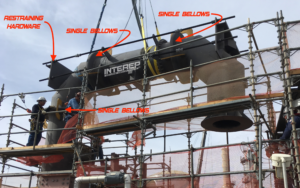
A universal expansion joint uses two bellows separated by a center spool to accommodate lateral movement more efficiently than a single bellows. That does not eliminate the need to understand anchors, guides, pressure thrust, intermediate piping, and the rotation imposed by connected equipment.
Rigid offsets deserve special attention. If a hot duct expands toward an elbow or offset that cannot translate as expected, the resulting rotation can be pushed into the expansion joint. Cracking at adjacent welds, bent hardware, uneven convolution spacing, or a joint that appears racked may be symptoms of a system movement problem rather than a bellows-strength problem.
Do not let an old specification choose the application
Replacement projects often begin with an old drawing, a copied refinery specification, or the nameplate from a failed unit. Those are useful inputs, but they are not a substitute for current design criteria.
For example, an elastomer that works in a lower-temperature service may be unsuitable for a high-temperature metallurgical or acid-gas system. A material name appearing in a legacy note does not establish that it is chemically or thermally compatible with the current service. The same is true for bellows alloy, liner alloy, external cover, braid, packing, insulation, and attachment materials.
INTEREP’s overview of selecting expansion joints for sulfuric acid plants illustrates why chemistry, temperature, corrosion environment, and maintainability have to be evaluated together.
Treat purge air as a design condition
Purge air is sometimes proposed to keep process gas or solids away from a cavity, liner gap, or bellows plies. It can also be used to hold bellows metal temperature within its allowable limit on high-temperature service, particularly where no internal liner is present. It should not be added as an isolated accessory decision.
The design review should ask what the purge does to local metal temperature, gas composition, condensation risk, corrosion regime, pressure balance, and flow pattern. Those questions may require thermal analysis, process input, corrosion expertise, or computational fluid dynamics. A model result should still be checked against realistic boundary conditions and plant operating cases.
If the consequence of getting the purge wrong is accelerated corrosion or a new cold spot in an acid-gas system, the assumptions deserve the same scrutiny as the expansion-joint calculation.
The replacement design checklist
- Define the operating cases, not just one design temperature and pressure. Include startup, shutdown, upset, cleaning, and standby conditions when relevant.
- Calculate relative movement at the joint for each case. Separate axial, lateral, angular, and torsional components.
- Confirm anchors, guides, supports, connected equipment loads, and pressure-thrust restraint.
- Inspect the failed joint and adjacent duct or pipe for evidence that identifies the actual load path.
- Recheck materials against temperature, chemistry, abrasion, corrosion, and external environment.
- Define the flow liner, cavity, insulation, cover, packing, and purge strategy as part of the joint design.
- Confirm installation dimensions and tolerances. Do not distort the replacement to force it into an incorrect opening.
- Review the final drawing and calculation with the owner, piping or duct engineer, and expansion-joint designer before fabrication.
Failure clues that point beyond the bellows
- Repeated cracking in the same attachment or adjacent duct location.
- Uneven convolution spacing or visible rotation across the flexible element.
- Bent tie rods, hinges, guides, or other restraint hardware.
- A center spool or connected duct that sits at an unexpected angle.
- A replacement joint that must be pulled, twisted, or compressed into the opening.
- A copied material specification that conflicts with the actual temperature or chemistry.
Engineer the motion before engineering the bellows
The best replacement is not automatically the strongest or largest expansion joint. It is the joint that matches the real movement and works with the surrounding system. That requires a clear movement model, verified design conditions, appropriate materials, and an installation opening that agrees with the design.
Every application is different. Final movement, materials, purge conditions, pressure thrust, anchors, guides, and allowable loads should be reviewed by qualified engineering personnel and the expansion-joint designer.
Frequently asked questions
Can a universal expansion joint absorb lateral movement?
Yes. Two bellows separated by a center spool can accommodate lateral movement efficiently when the joint, restraints, anchors, guides, and connected system are designed together.
Can metal bellows handle torsion?
Torsion should be avoided. EJMA identifies torsion as a condition that reduces bellows life and can cause failure.
Will adding more convolutions fix repeated failures?
Not necessarily. More flexibility may change spring rate and movement capacity, but it does not correct an unmodeled load path, bad anchoring, installation distortion, or incompatible materials.
Why inspect adjacent piping and ductwork after a bellows failure?
Cracks, bent hardware, offset, and support movement outside the joint can reveal where the real load is coming from.
Can an old expansion-joint specification be reused?
It can be a starting point, but current movement, operating cases, chemistry, temperature, pressure, materials, and installation dimensions must be verified.
What should be checked before adding purge air?
Review the purge flow, temperature, pressure, gas composition, local cooling, condensation risk, corrosion effects, and behavior across all operating cases.
What installation measurement matters most?
There is no single universal measurement. The as-installed face-to-face, offset, rotation, flange alignment, and joint orientation should be checked against the approved drawing and design cold setting.
References and related INTEREP resources
- EJMA Bellows Basics: movement types, cycle life, flow liners, and torsion
- EJMA Expansion Joint Types: standard joint configurations
- INTEREP Metal Bellows Expansion Joints: product overview
- Selecting Expansion Joints for Sulfuric Acid Plants: materials and application context
- INTEREP acid-plant flanged-and-flued field example: related field content
When Thermal Growth Becomes Torsion