
Aging Metal Bellows Expansion Joints in Steam Service
What a refinery found before the next failure
Published by the INTEREP Engineering Team
Technical review: Raffy Mark Osorio, Applications Engineer
Published August 12, 2026
One expansion joint had already ruptured. The remaining joints were still operating, but decades of service, active corrosion, and missing design records made their remaining life impossible to confirm from appearance alone. An online inspection gave the refinery the evidence it needed to plan the next step before another failure forced the decision.
Problem overview
A U.S. petroleum refinery contacted INTEREP after a metal bellows expansion joint ruptured in a low-pressure steam system. Rather than wait for another failure, the refinery asked INTEREP to perform a live, online inspection of the remaining four expansion joints while the line stayed in operation.
The system serves the refinery’s tank farm. Low-pressure steam systems often receive less attention than high-pressure systems, but a rupture still creates serious safety, reliability, and downtime risks. Inspecting the remaining joints after the first failure was the right decision.
Plant and process context
The four inspected assemblies were 12-inch NPS, single unrestrained metal bellows expansion joints installed horizontally in the same low-pressure steam piping system. The system operates at approximately 400°F and 25 psig. Original drawings, installation records, and confirmed installation dates were not available during the inspection.
System conditions and inspection limits
Every heat-up and cooldown cycle forces a bellows element to compress and extend with the piping system. Over decades of service, that repeated movement accumulates fatigue even when the joint looks stable from the outside. Corrosion and missing design documentation add uncertainty because the measured operating position cannot be compared with the joint’s original rated movement capacity.
The inspection was performed with the steam system online. Because the joints remained in operation and insulated, the inspection could not verify internal bellows condition, multi-ply separation, or full structural integrity. Those limitations are important: a hot inspection can identify visible warning signs, but it cannot answer every remaining-life question.
Core issue and inspection findings
The inspection did not establish a single root cause for the original rupture. It did identify the same concern across the four remaining joints: advanced service age, active corrosion, and no original design documentation.
A root-ring stamping on at least one joint appeared to identify a manufacturer that stopped production around 1983. If the assemblies were original to the installation, they may have been in service for more than 40 years. No available records could confirm that estimate.
Findings across the four inspected joints:
- Active corrosion on bellows convolutions
- Corrosion on root rings and assembly hardware
- Weld spatter on attachment welds at multiple joints
- No active steam leakage observed during the inspection
- No localized hot spots or thermal anomalies detected with FLIR thermal imaging
- Measured bellows surface temperatures of approximately 227°F to 235°F
- No visible external squirm, deformation, or weld cracking
Nothing was actively failing during the inspection. That was the good news. The concern was the uncertainty surrounding remaining service life and whether the joints were still operating inside their original movement limits. A bellows assembly can appear stable externally while operating outside its intended movement envelope.
Relevant failure mechanisms include cyclic fatigue, corrosion-assisted cracking of the bellows element, and squirm instability if actual movement or pressure conditions exceed the original design limits.
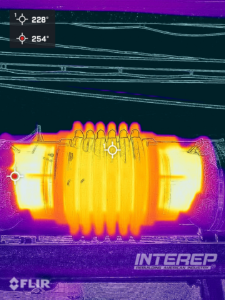 FLIR thermal image captured during the online inspection. The surface-temperature pattern did not show a localized hot spot or active steam leak. © INTEREP.
What INTEREP did
INTEREP completed a hot, online inspection of all four joints. The scope included:
- External visual examination of bellows convolutions, root rings, attachment welds, and assembly hardware
- Four-point hot operating dimensional measurements at each joint
- FLIR thermal imaging to identify localized temperature anomalies
- Photographic documentation of observed conditions
- A written inspection report with condition ratings and prioritized recommendations
Movement calculations could not be completed because original design drawings and cold installation dimensions were unavailable. Establishing actual operating movement requires comparing hot dimensions with cold baseline dimensions collected during a shutdown, either through conventional field measurements or 3D laser scanning. Without the cold baseline and original design data, hot-only measurements document operating geometry but cannot confirm whether a joint remains within its rated movement envelope.
INTEREP recommended two next steps:
- Perform a cold, offline inspection during the next planned shutdown to establish baseline dimensions and evaluate actual operating movement.
- Plan to replace all four joints based on observed corrosion, estimated service age, and the failure already experienced elsewhere in the system.
INTEREP engineers and supplies custom metal bellows expansion joints for refinery steam applications. Replacement assemblies can be matched to existing face-to-face dimensions or redesigned around verified movement, pressure, temperature, materials, and piping geometry. The objective is a correctly specified replacement that resolves the underlying application requirements rather than simply copying an undocumented legacy design.
Key specifications
| Parameter | Detail |
| Plant type | U.S. petroleum refinery |
| System | Tank farm low-pressure steam |
| Joints inspected | 4 |
| Nominal diameter | 12 inches NPS |
| Expansion joint type | Single, unrestrained metal bellows |
| Design temperature | 400°F |
| Design pressure | 25 psig |
| Media | Low-pressure steam |
| Orientation | Horizontal |
| Estimated age | 40+ years if original to the installation |
| Observed condition | Fair; active corrosion, no active leaks |
| Inspection method | Hot/online visual, dimensional, and thermal imaging |
| Urgency rating | Medium – plan corrective work before another failure |
Lessons learned
Low pressure does not mean low consequence. Age, corrosion, and accumulated movement cycles can materially change the risk of a system that would otherwise be considered mild service.
One rupture should trigger a system-level review. Joints installed at the same time and exposed to the same operating conditions may share the same failure mechanisms.
Hot inspections are valuable, but they have limits. They can document visible corrosion, thermal behavior, leakage, and operating geometry without a shutdown. Cold access is still needed for a more complete assessment.
Original documentation matters. Without drawings and cold installation dimensions, engineers cannot confirm whether a joint is operating inside its rated movement range.
Uncertainty is itself a planning signal. Decades-old, corroded bellows with missing records and a recent sister-joint failure belong on a replacement plan even when they are not leaking today.
Medium urgency still requires action. It means plan and execute corrective work before the condition becomes an emergency, not wait until the next rupture.
Frequently asked questions
Why do metal bellows expansion joints fail in low-pressure steam systems?
Low pressure does not eliminate cyclic fatigue. Metal bellows accumulate damage from repeated thermal expansion and contraction throughout their service life. Corrosion, material aging, installation damage, and limited inspection history can further reduce confidence in remaining life.
What can a hot expansion joint inspection detect?
A hot inspection is performed while the system remains online. It can identify visible corrosion, weld or hardware issues, active leakage, thermal anomalies, and abnormal operating geometry. It cannot fully assess internal bellows condition, ply separation, or movement relative to original design limits.
What is the difference between a hot inspection and a cold inspection?
A hot inspection captures the joint in its operating position without requiring a shutdown. A cold inspection provides access during an outage and establishes baseline dimensions. Comparing hot and cold measurements provides a much stronger basis for evaluating actual movement.
How do you determine whether an expansion joint has exceeded its design movement limits?
Engineers compare the cold installed length with the measured hot operating length, then compare the calculated movement with the manufacturer’s rated movement. Where field geometry is complex or legacy dimensions are uncertain, 3D laser scanning can improve the dimensional record. Original design information is still needed to confirm the rated envelope.
When should aging expansion joints be replaced rather than monitored?
Replacement becomes the more defensible plan when joints have decades of service, active corrosion, missing design records, or a related failure in the same system. Continued monitoring may document deterioration, but it does not restore lost design certainty or structural margin.
Need help evaluating an aging expansion joint?
INTEREP can help with online inspections, shutdown inspections, reverse engineering, movement evaluation, and replacement expansion joints. Contact INTEREP to discuss the application before another failure determines the schedule.
Related resources: Metal Bellows Expansion Joints | INTEREP Expansion Joint Installation Guide | INTEREP Project Library
Aging Metal Bellows Expansion Joints in Steam Service