
PTFE Geomembrane Liners for High-Temperature Containment
Why PTFE Changes the Containment Life-Cycle Conversation
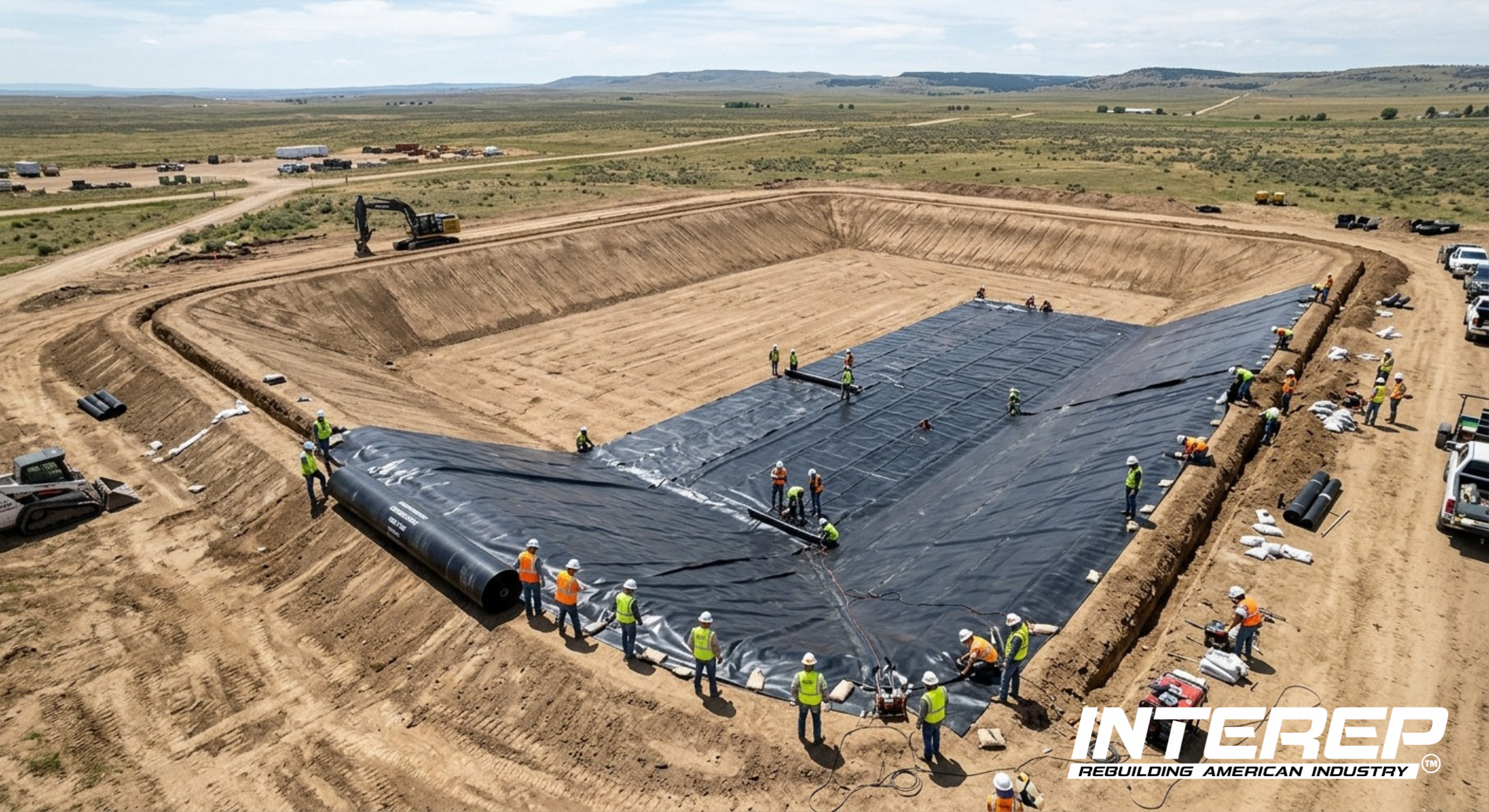
Most geomembrane liners fail from the top down, not the bottom up. The chemical resistance is usually fine. What gives out first is the exposed surface: UV breakdown, embrittlement, and cracking at the seams after two or three seasons in direct sun, especially on liners running near their upper temperature limit. By the time a plant notices surface crazing, the liner is already losing tensile strength and the containment margin is shrinking.
PTFE geomembrane liners address that failure mode directly. The fluoropolymer surface does not rely on a UV stabilizer package that depletes over time; PTFE is inherently unaffected by UV exposure and can operate across a temperature range that extends well beyond conventional HDPE, LLDPE, and PVC liner materials. INTEREP offers 100% PTFE high-temperature geomembrane liner systems for demanding containment applications where corrosion, chemical compatibility, UV exposure, or temperature can become the limiting factors in conventional liner materials.
Where standard liners run out of margin
Geomembrane liners see three failure drivers in the field: UV exposure, thermal cycling, and chemical attack. Most liner selection processes optimize for chemical compatibility and stop there, because that’s the spec sheet number everyone checks first. Thermal and UV performance get treated as secondary until a liner starts cracking at the anchor trench or losing flexibility in the field seams.
That’s usually where PTFE liners get evaluated, not at initial design, but after a first-generation liner has already failed early. The applications that push standard liners hardest:
- Secondary containment under equipment running hot process fluids, where ambient sun exposure combines with radiant heat off nearby vessels or piping
- Evaporation ponds and lined basins in high-UV climates with no shading
- Tank farm containment where liner life needs to match or exceed the tank’s inspection interval
- Any lined containment area near flare stacks, furnaces, or other radiant heat sources where liner surface temperature runs well above ambient
In all of these, the liner is doing two jobs at once: containing whatever it’s supposed to contain, and surviving the environment it’s installed in. Standard liners are usually sized for the first job and undersized for the second.
What PTFE brings to the liner
PTFE’s chemistry doesn’t have the double bonds that UV radiation attacks in most polymer liner materials, which is why the material doesn’t need a sacrificial UV inhibitor to hold its properties over time. It also has one of the highest continuous service temperature ratings of any liner material on the market, which matters less for the “will it melt” question and more for the “will it stay flexible at the seams after ten years in the sun” question.
The trade-off is upfront cost. PTFE liner material runs higher per square foot than HDPE or PVC. The way to think about that isn’t material cost, it’s total cost over the containment area’s service life: liner replacement means an outage, excavation or access work around the liner perimeter, and re-qualification of the containment system. A liner rated to outlast two or three replacement cycles of a standard material changes that math, especially anywhere access for a re-line is difficult or expensive.
Key Specifications
Property |
Typical Value |
| Base material | PTFE (fluoropolymer) geomembrane |
| Continuous service temperature | High-temperature rated, exceeds standard HDPE/LLDPE/PVC liners |
| UV resistance | Inherent, no dependent UV stabilizer package |
| UV performance / warranty | Inherently resistant to UV degradation. Project-specific warranty or guarantee terms are available based on the operating conditions and application requirements, with warranty periods up to 30 years available for qualifying service conditions. |
| Chemical resistance | Broad resistance across acids, bases, and most process chemicals (confirm compatibility for specific media) |
| Typical thickness range | Application-dependent, sized to containment volume and installation method |
| Seaming method | Thermal/fusion seaming appropriate to PTFE liner systems |
| Common applications | Secondary containment, lined basins and ponds, tank farm containment, high-heat containment areas |
Exact thickness, seam detail, and anchor design are sized to the specific containment area, service temperature, and chemical exposure. Reach out to INTEREP with your containment dimensions and process conditions for a liner spec.
Frequently Asked Questions
-
How does a PTFE liner’s UV resistance compare to a UV-stabilized HDPE liner?
HDPE and LLDPE liners rely on additive UV stabilizers that deplete gradually with sun exposure. Once depleted, degradation accelerates. PTFE’s UV resistance comes from the base polymer chemistry, so there’s no depletion curve to plan around.
-
Is PTFE liner material compatible with high-temperature process fluids?
PTFE has one of the highest continuous service temperature ratings of any geomembrane material available, which is why it’s specified for containment areas near hot equipment, flare stacks, or high-ambient-heat installations. Confirm the specific temperature and chemical exposure with INTEREP before finalizing material selection.
-
Does the PTFE geomembrane carry a time-based UV warranty?
Yes. Warranty and guarantee terms are established on a project-specific basis according to the operating conditions, including service temperature, chemical exposure, UV exposure, installation environment, and other application requirements. For qualifying applications, warranty periods up to 30 years are available. INTEREP reviews the service conditions for each project and provides the applicable warranty or guarantee terms with the project quotation.
-
Can PTFE liners be installed in an existing containment area without full excavation?
In some cases, installers can place PTFE liner systems over existing containment surfaces or use them for relining. However, the substrate condition and anchor points must support that approach. Therefore, a site assessment determines whether full excavation is necessary.
-
How does liner life factor into total cost versus a lower-cost liner material?
A standard liner replacement isn’t just material cost, it typically means taking the containment area out of service, addressing access constraints, and re-qualifying the system. A liner sized to outlast two or three replacement cycles of a standard material shifts the cost comparison from per-square-foot price to total cost over the containment area’s service life.
Talk with INTEREP
Send INTEREP your containment dimensions, service temperature, and chemical exposure before selecting a liner. Then, our team can help compare PTFE with conventional materials based on your site’s operating conditions and containment requirements.
PTFE Geomembrane Liners for High-Temperature Containment