
When the Bellows Manufacturing Method Is a Pass-Fail Requirement
Hydroformed, punch-formed, and roll-formed are not interchangeable when the owner specification names an allowed process.
By INTEREP Engineering Team
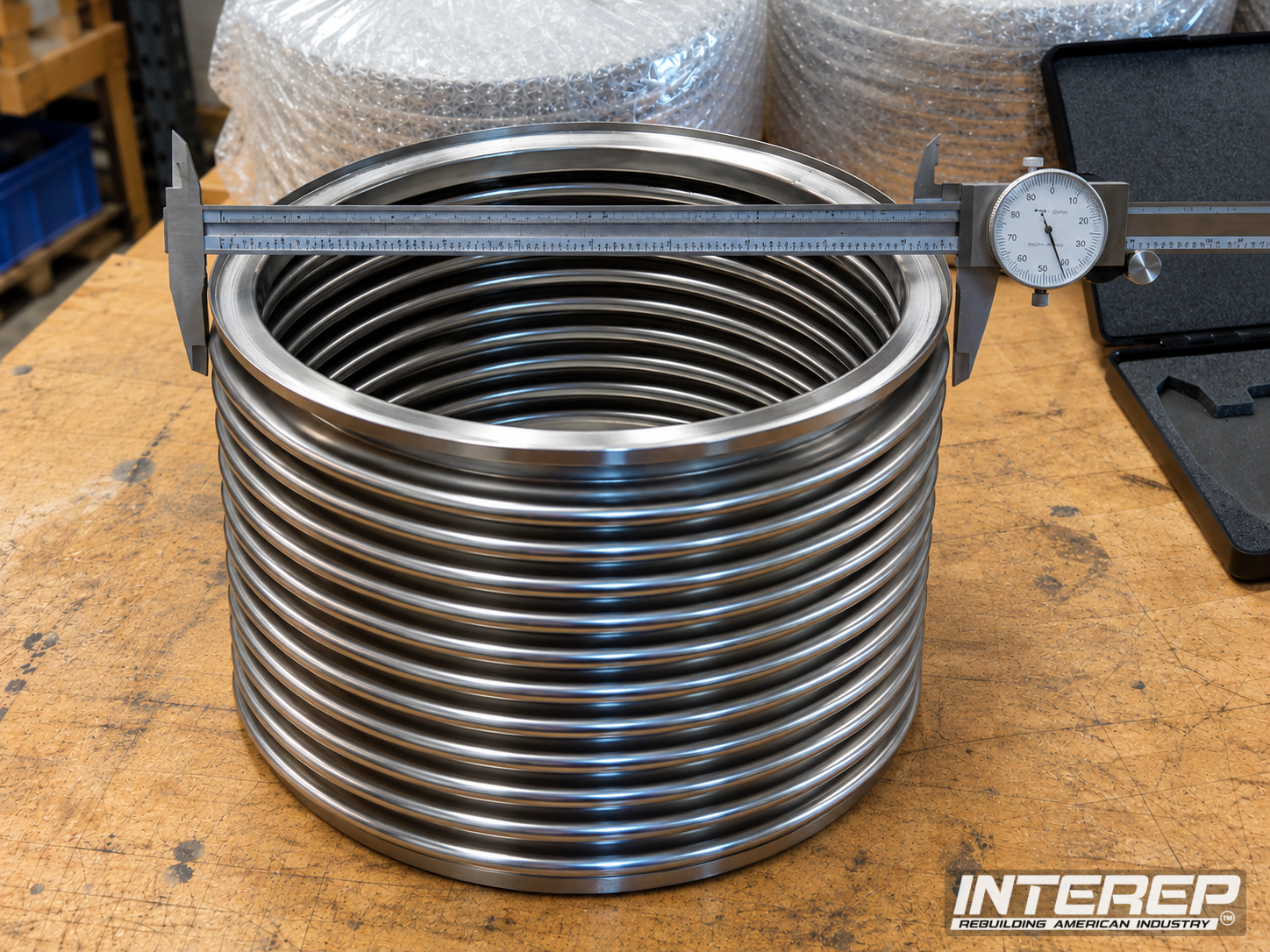
Hydroformed vs. Roll-Formed Bellows: Why Specification Compliance Comes First
Metal bellows can be manufactured using several forming methods, and each method has its own practical advantages, limitations, and applications. For an end user, however, the most important consideration is not simply which forming method is preferred by a manufacturer. It is whether the finished expansion joint complies with the requirements established for the specific application.
When an owner or engineering specification identifies an acceptable bellows-forming method, that requirement becomes part of the design basis. Pressure, temperature, movement, cycle life, material, overall dimensions, and manufacturing method must all be evaluated together.
At INTEREP, specification compliance begins before the expansion joint is released for manufacture.
- Bellows-forming requirements should be reviewed alongside pressure, temperature, movement, material, and dimensional requirements.
- Hydroformed, mechanically formed, and roll-formed bellows can all be appropriate depending on the application and governing specification.
- A technically functional design may still require customer approval if it differs from a specified manufacturing method.
- Dimensional constraints can sometimes conflict with other design requirements and should be identified before fabrication.
- Deviations from the project specification should be clearly documented and resolved before an expansion joint is released for manufacture.
Why Bellows Forming Method Matters
The bellows is the flexible element of a metal expansion joint. Its geometry allows the expansion joint to absorb axial, lateral, and angular movement while containing the system pressure.
Bellows convolutions can be produced using different manufacturing processes.
Hydroforming uses controlled internal fluid pressure and tooling to form the convolutions.
Mechanical or punch forming uses dies and controlled mechanical force to progressively form the bellows geometry.
Roll forming creates convolutions through controlled local deformation as the bellows material is progressively formed.
Each process can produce reliable bellows when properly designed and manufactured. The appropriate method depends on factors such as:
- Bellows diameter
- Material and wall thickness
- Number of plies
- Convolution geometry
- Pressure
- Required movement
- Cycle life
- Tooling capability
- Inspection requirements
- Applicable codes and project specifications
For this reason, forming method should not be evaluated independently from the rest of the expansion joint design.
Is Hydroforming Better Than Roll Forming?
Not necessarily.
There is no single forming process that is universally superior for every expansion joint application. The suitability of a bellows depends on the complete design and service conditions.
A properly engineered roll-formed bellows may perform very well in one application, while another project may specifically require hydroforming or mechanical forming because of an owner specification, project standard, qualification requirement, or established engineering practice.
The important distinction is between technical suitability and specification compliance.
An expansion joint may be technically capable of performing the required service while still differing from a requirement contained in the project specification. When that occurs, the difference should be identified and reviewed rather than assumed to be acceptable.
Why Overall Length Can Affect Bellows Design
One of the most common challenges in metal expansion joint design is fitting the required performance into the available space.
The designer must balance several requirements at the same time, including:
- Overall expansion joint length
- Axial movement
- Lateral movement
- Angular movement
- Design pressure
- Design temperature
- Bellows material
- Required fatigue life
- Bellows forming method
- Flange or weld-end configuration
- Internal liner requirements
- Tie rods, hinges, gimbals, or other hardware
A short overall length can significantly restrict the available bellows geometry.
For example, additional convolutions or bellows live length may be necessary to accommodate movement while maintaining acceptable stresses and fatigue life. If the installation envelope does not provide sufficient room, the manufacturer may need to evaluate an alternate configuration.
In these situations, the correct solution is not simply to force the expansion joint into the available space. The dimensional limitation and its effect on the design should be discussed with the end user or engineer so the requirements can be reconciled before fabrication.
Specification Compliance Is More Than Code Compliance
Expansion joints are commonly designed using recognized industry standards such as EJMA and, where applicable, ASME requirements. These standards provide important criteria for design, materials, fabrication, testing, and quality.
However, meeting an industry code or standard does not automatically satisfy every requirement contained in an owner or project specification.
A project may include additional requirements covering:
- Bellows forming method
- Material grades
- Number of bellows plies
- Welding procedures
- Nondestructive examination
- Pressure testing
- Material traceability
- Heat treatment
- Inspection hold points
- Documentation
- Approved manufacturing processes
These requirements become part of the project-specific design basis.
INTEREP reviews the applicable specification together with the operating conditions so that both the mechanical design and project requirements are considered before manufacture.
What Happens When Requirements Conflict?
Occasionally, two project requirements cannot be satisfied simultaneously without modifying the design.
For example, an expansion joint may have:
- A strict maximum overall length
- A specified bellows-forming method
- A large required movement
- A defined pressure and temperature
- A required fatigue life
Individually, each requirement may be reasonable. In combination, however, they may restrict the available design options.
When this occurs, the conflict should be identified before fabrication.
Depending on the application, possible solutions may include:
- Increasing the available overall length
- Revising the movement distribution
- Changing the expansion joint configuration
- Evaluating a universal or restrained design
- Revising bellows geometry
- Reviewing alternate materials or construction
- Requesting an approved deviation from a project-specific requirement
The appropriate solution depends on the piping or duct system and should be reviewed with the owner or engineer responsible for the system.
How INTEREP Reviews Metal Expansion Joint Requirements
As a metal expansion joint manufacturer, INTEREP evaluates the entire application rather than treating the bellows as an isolated component.
Our engineering review typically considers:
- Operating Conditions
Design and operating pressure, temperature, process media, and environmental conditions.
- Required Movements
Axial compression and extension, lateral movement, angular movement, and expected combinations of movement.
- Installation Envelope
Nominal pipe or duct size, face-to-face length, connection type, and surrounding equipment limitations.
- Bellows Design
Material, number of plies, convolution geometry, forming method, spring rate, pressure capacity, and fatigue requirements.
- Expansion Joint Configuration
Single, universal, tied universal, hinged, gimbal, externally pressurized, pressure-balanced, or other configurations as required.
- Project Specifications
Owner standards, engineering specifications, EJMA requirements, ASME requirements where applicable, inspection requirements, and documentation requirements.
- Manufacturing and Inspection Requirements
Welding, forming, nondestructive examination, pressure testing, material traceability, and quality documentation.
This approach helps ensure the expansion joint is not only capable of performing mechanically but is also aligned with the requirements of the project.
Questions End Users Should Ask When Reviewing an Expansion Joint
When purchasing or replacing a metal expansion joint, it can be helpful to confirm:
- What forming method is required by the project specification?
- Is that requirement mandatory, or are approved alternatives permitted?
- What movements must the expansion joint accommodate?
- Are movements expected individually or simultaneously?
- What cycle life is required?
- Is the available face-to-face dimension fixed?
- Are there installation or piping-load limitations?
- What inspection and testing are required?
- Is material traceability required?
- What design standard governs the expansion joint?
- Are there owner-specific requirements beyond EJMA or ASME?
Providing this information early allows the manufacturer to evaluate the application as a complete system rather than making assumptions that may need to be corrected later.
Engineering criteria, limits and caveats
When reviewing a project specification, several details deserve particular attention.
“Mechanically formed” may require clarification.
Terminology can vary between specifications. If a specification identifies a particular forming method, the intended definition should be understood before fabrication.
Bellows requirements may differ from assembly requirements.
Some specifications apply specifically to the bellows element, while others govern the complete expansion joint assembly.
Forming method is only one part of bellows performance.
Material, ply construction, convolution geometry, weld quality, heat treatment, pressure, movement, and fatigue life all contribute to the final design.
Available space can become a design constraint.
A replacement expansion joint may need to fit an existing installation, but duplicating the original dimensions does not automatically mean the new design will satisfy different operating or specification requirements.
Any approved deviation should be documented.
If a project requirement must be changed, written approval helps ensure that the owner, engineer, and manufacturer are working from the same design basis.
Takeaways
- Hydroformed, mechanically formed, and roll-formed bellows can all be appropriate when properly applied.
- The project specification determines whether a particular manufacturing method is required.
- Bellows forming method should be evaluated together with movement, pressure, temperature, fatigue life, material, and available installation space.
- A design can be mechanically sound while still requiring approval for a project-specific specification deviation.
- Identifying conflicts early gives the end user more options and helps avoid redesign, fabrication delays, or field fit-up problems.
Frequently asked questions
Is a hydroformed bellows always better than a roll-formed bellows?
No. Both processes can produce reliable bellows. The appropriate manufacturing method depends on the application, bellows geometry, material, required performance, manufacturing capability, and governing project specification.
Why would an owner specify a particular bellows-forming method?
Owner and engineering specifications may reflect previous operating experience, internal standards, qualification requirements, inspection practices, or project-specific engineering criteria. When a manufacturing method is explicitly required, it should be treated as part of the project design basis.
What happens if the specified expansion joint will not fit in the available space?
The manufacturer should evaluate the required movements, pressure, temperature, cycle life, and construction to determine what is controlling the design. INTEREP can then work with the customer to evaluate practical alternatives before fabrication begins.
Does EJMA or ASME compliance override an owner specification?
Not automatically. Industry codes and standards establish important design and fabrication requirements, but a project specification may contain additional requirements. The applicable contract documents and order of precedence should be reviewed for the specific project.
Can the forming method affect expansion joint dimensions?
Yes. Bellows geometry, manufacturing process, material thickness, number of convolutions, pressure requirements, and required movement can influence the live length of the bellows and ultimately the overall assembly length.
When should specification exceptions be identified?
Ideally, during the quotation and engineering review process and before the expansion joint is released for manufacture. Resolving exceptions early gives the customer and manufacturer the greatest flexibility to develop an appropriate solution.
Talk with INTEREP
Metal expansion joints must satisfy more than a dimensional drawing. Pressure, temperature, movement, fatigue life, materials, manufacturing requirements, installation constraints, and owner specifications all influence the final design.
Send INTEREP your operating conditions, required movements, dimensional envelope, and applicable project specifications early in the process. Our team can review the complete application, identify potential conflicts, and develop an expansion joint that meets both the mechanical requirements of the system and the requirements of the project.
This article kind of sounds like we are telling distributors how to deal with vendors.. Or maybe an internal feel rather than a helpful article for end users
Hydroformed vs. Roll-Formed Metal Bellows Expansion Joints