
Staged Expansion Joint Shipments Only Work When the Field Sequence Is Engineered
One unit arriving early can help an outage, but only if drawings, hardware, access, inspection and installation readiness move with it.
By INTEREP Engineering Team
Staged Expansion-Joint Delivery for Outages: A Field-Readiness Checklist
An expedited shipment is useful only when the first arriving unit can be installed, inspected and released without waiting on the rest of the package.
At a glance
- Tie fabrication sequence to the site’s replacement sequence.
- Release a complete installable unit, not a partial collection of steel, belt and hardware.
- Treat drawings, QA records, shipping marks and field support as part of the staged shipment.
The schedule problem is not just the ship date
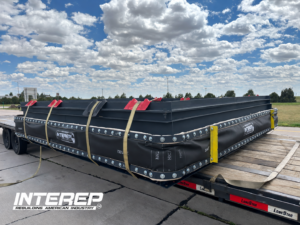
This pattern shows up on an outage-critical order when shifting dates and needs dictate the need for an expedited delivery schedule. On a recent order for multiple full-frame fabric expansion joints, we completed the first unit before the rest of the set and had to decide, together with the site, whether shipping it ahead of schedule actually helped the outage window or just moved the bottleneck downstream. The outage needed several units in one work window and the balance shortly after, so the answer depended on whether that first unit could be received, inspected and released as a complete package on its own.
Staging can buy time, but only if each shipment matches an install location and arrives as a complete, accepted package. One frame onsite is not progress if the matching flexible element, insulation, fasteners, drawings or inspection records are somewhere else.
Define the minimum installable package
For each location, our release list identifies the frame sections, flexible element, liner components, clamp bars, bolts, gaskets, splice materials, labels and special tools. If field welding or belt splicing is required, the procedure and qualified personnel are scheduled with the hardware.
Each crate carries a location identifier that matches the approved drawing and site sequence. We avoid markings that are meaningful only to our shop. The field team should be able to receive, inventory and stage the unit without reconstructing the order from emails.
QA and documentation have to travel with the first unit
The first unit we release gets the same drawing, dimensional, material and workmanship review as the final unit. Expedited does not mean incomplete acceptance. If we are still learning from the first build, our inspection plan captures the features that must be repeated or corrected on later units.
Our shipment release can require approved drawing revision, dimensional report, material traceability, visual inspection, photographs, packing list and nonconformance status. The owner of each item is clear before the truck is booked.
Connect the shop forecast to the outage plan
A forecast by unit is more useful to the site than a single “complete by” date from us. It lets the site decide installation order, crane windows, scaffold moves and labor loading. It also reveals when a late component will make an otherwise finished frame unusable.
Our schedule shows fabrication complete, QA release, freight pickup, ETA, site receipt, installation readiness and field-support availability. Changes need one owner and one current source, not conflicting email chains.
Decision framework
- Map every unit to its field location and planned installation window.
- Define the complete installable package and required documents for each location.
- Sequence our shop work around the field need while preserving QA hold points.
- Release and label each shipment only after shipment releasing requirements are met.
- Track unit-by-unit ETA, receipt, field support and installation readiness through outage closeout.
Engineering criteria, limits and caveats
- Confirm whether frames, liners, belts and insulation can be shipped or installed separately without damage or rework.
- Protect flexible elements and finished surfaces during storage and staged handling.
- Include all hardware with a counted, location-specific packing list.
- Do not skip shipment releasing requirements because the freight schedule is urgent.
- Plan field splicing, welding, insulation and technical supervision before the unit ships.
Takeaways
- Staged shipping works when our fabrication sequence and the field sequence are the same plan.
- Completeness and QA matter more than the number of trucks dispatched.
- Unit-level forecasting gives the outage team information it can actually use.
Frequently asked questions
What is a complete installable shipment?
The specific frame, flexible element, liner, insulation, hardware, procedures and approved documents required to install one location without waiting on another shipment.
Can a frame ship before the belt?
Sometimes, but only when storage, installation sequence and protection are engineered and the site agrees. Shipping early should not create damage or rework.
How do we label staged crates?
By site location and approved drawing identifiers, with a packing list the receiving team can verify.
What makes our fabrication forecast useful to the outage team?
A unit-by-unit sequence with fabrication, QA release, pickup and arrival dates, plus the constraint and owner for any at-risk unit.
Talk with INTEREP
If your outage schedule is tightening, send us the site sequence, approved drawings and installation constraints. We’ll turn staged shipping into complete, installable releases.
References and related INTEREP resources
- INTEREP Expansion Joint Installation Guide: inspection and installation guidance
- INTEREP Metal Bellows Expansion Joints: product and application overview
- INTEREP Projects: field examples and related work
- Field example: infrared thermal survey: related INTEREP field content
Staged Expansion Joint Delivery for Outages